
Auto Insurance Claim Letter Template
File a formal auto insurance claim. This professionally drafted template provides a clear, well-structured format that you can customize for your specific situation.
When to Use This Letter
Use this to formally file a claim after an accident, theft, vandalism, or weather damage. Provides a clear record of the incident and your coverage expectations.
What This Template Includes
- Professional structure and formatting
- Fill-in-the-blank placeholders for names, dates, and details
- Formal, business-appropriate tone
- Both DOCX (editable) and PDF (printable) versions
- Compatible with Microsoft Word, Google Docs, and similar editors
How to Use
- Download the template in DOCX or PDF format
- Open in your preferred editor
- Replace the bracketed placeholders with your information
- Review, print or save, and send
Instant download • DOCX + PDF • Lifetime access
Template Preview
Here’s the opening of this letter so you can see the format and tone. The complete, ready-to-send version, with every section written out, comes in the editable DOCX & PDF download.
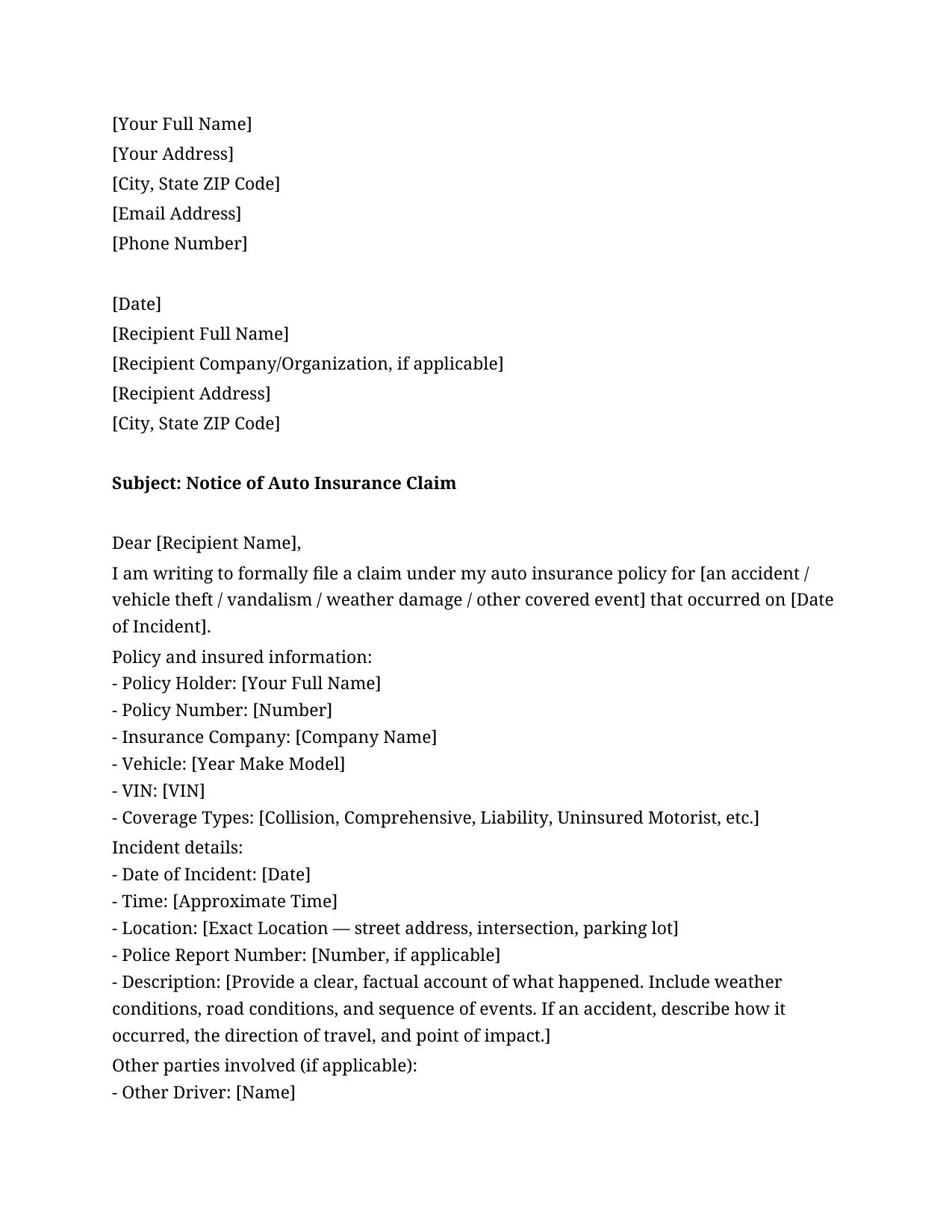
[Your Full Name]
[Your Address]
[City, State ZIP]
[Date]
[Insurance Company Name]
Attn: Claims Department
[Insurance Company Address]
[City, State ZIP]
RE: Auto Insurance Claim, Policy [Policy Number], Claim [Claim Number, if assigned], Date of Loss: [Date of Loss]
Dear Claims Department:
I am writing to formally submit a claim under my auto insurance policy, number [Policy Number], for damage to my [Year, Make, and Model], VIN [Vehicle Identification Number], arising from an incident that occurred on [Date of Loss] at approximately [Time of Loss] at [Location of Incident].
You’re seeing a preview. The full letter continues in the download.
Get the complete, ready-to-send letter as an editable DOCX + print-ready PDF, with every [placeholder] laid out as a fill-in field.
Get 8 Automotive Vehicle Dispute Templates – $15
Instant download · DOCX & PDF · Lifetime access
Secure Stripe checkout · Apple Pay & Google Pay · Refund policy: duplicates & technical issues covered
How to Write an Auto Insurance Claim Letter
A claim letter does one job: it puts your claim on the record in a form the insurer has to respond to. To do that job well it needs six things:
- Identify the policy and the vehicle precisely. Policy number, claim number if one has been assigned, and the vehicle’s year, make, model, and VIN. Claims stall most often over mismatched identifiers, not disputed facts.
- Pin down the incident: date, time, place. “On [date] at approximately [time] at [location]”. The same details the police report and any witness statements will carry. Consistency across documents is what adjusters check first.
- Describe what happened factually, without admitting fault. State the sequence of events as you observed it. Leave conclusions about blame to the adjuster; a sentence like “I misjudged the distance” in writing can follow the claim through every later stage.
- List the damage and attach your evidence. Photos, the police report number, repair estimates, and receipts for towing or a rental car. Name each enclosure in the letter so the file shows what you sent and when.
- Ask for specific action. A claim number, an adjuster assignment, an inspection date, and a written response. Open-ended letters get open-ended timelines.
- Send it so you can prove it arrived. Certified mail with return receipt, or the insurer’s documented upload portal. And keep a copy of everything. Most policies require “prompt” notice of a loss, so send the letter within days of the incident, not weeks.
Auto Insurance Claim FAQ
I already filed by phone or through the app, do I still need a letter?
A phone call starts the claim; a letter documents it. For minor claims the app may be enough. For anything involving significant damage, an injury, a dispute about coverage, or a slow-moving adjuster, a written claim letter creates the dated record you’ll rely on if the claim is delayed or denied.
How soon do I have to file?
Almost every policy requires notice “promptly” or “as soon as practicable” after a loss, and some coverages carry specific deadlines. Late notice is one of the easiest grounds an insurer has to deny a claim, send written notice within days of the incident even if you’re still gathering estimates.
Do I send this to my insurer or the other driver’s?
Both situations use the same structure. A claim under your own policy (collision, comprehensive, uninsured motorist) goes to your insurer with your policy number. A liability claim against the at-fault driver goes to their insurer, identified by their policyholder’s name and policy number from the exchange of information. The template’s placeholders work for either.
Should I give the other driver’s insurer a recorded statement?
You’re generally not obligated to give a recorded statement to the other driver’s insurance company, and adjusters can use one to lock in details before you know the full extent of damage or injury. Put the facts in writing instead. Your own policy does require you to cooperate with your own insurer. And if anyone was injured, it’s worth talking to an attorney before giving any statement.
What if the claim is denied or the offer is too low?
Respond in writing and ask for the specific policy language behind the decision. Then escalate step by step: an insurance claim denial appeal letter first, an auto insurance dispute letter if the disagreement is over the settlement amount, and a complaint to your state insurance commissioner if the insurer stops engaging.
Not ready to buy? Start with 3 free templates.
Enter your email and we'll send the download link: a demand payment letter, formal resignation letter, and lease termination letter, in DOCX + PDF.